
- Vile Parle Clinic +91 9372467636
- Charni Road Clinic +91 7400337391
- Mon to Sat By Appointment Only
You have completed your fertility investigations, your IVF cycle is planned, and you are preparing for embryo transfer. Then your doctor suggests one more procedure: Hysteroscopy.
Naturally, questions arise. Why do I need another test? Wasn't my ultrasound normal? Can something be missed on a scan? Will hysteroscopy improve my chances of pregnancy?
Let's understand why your fertility specialist may recommend looking inside the uterus before IVF.
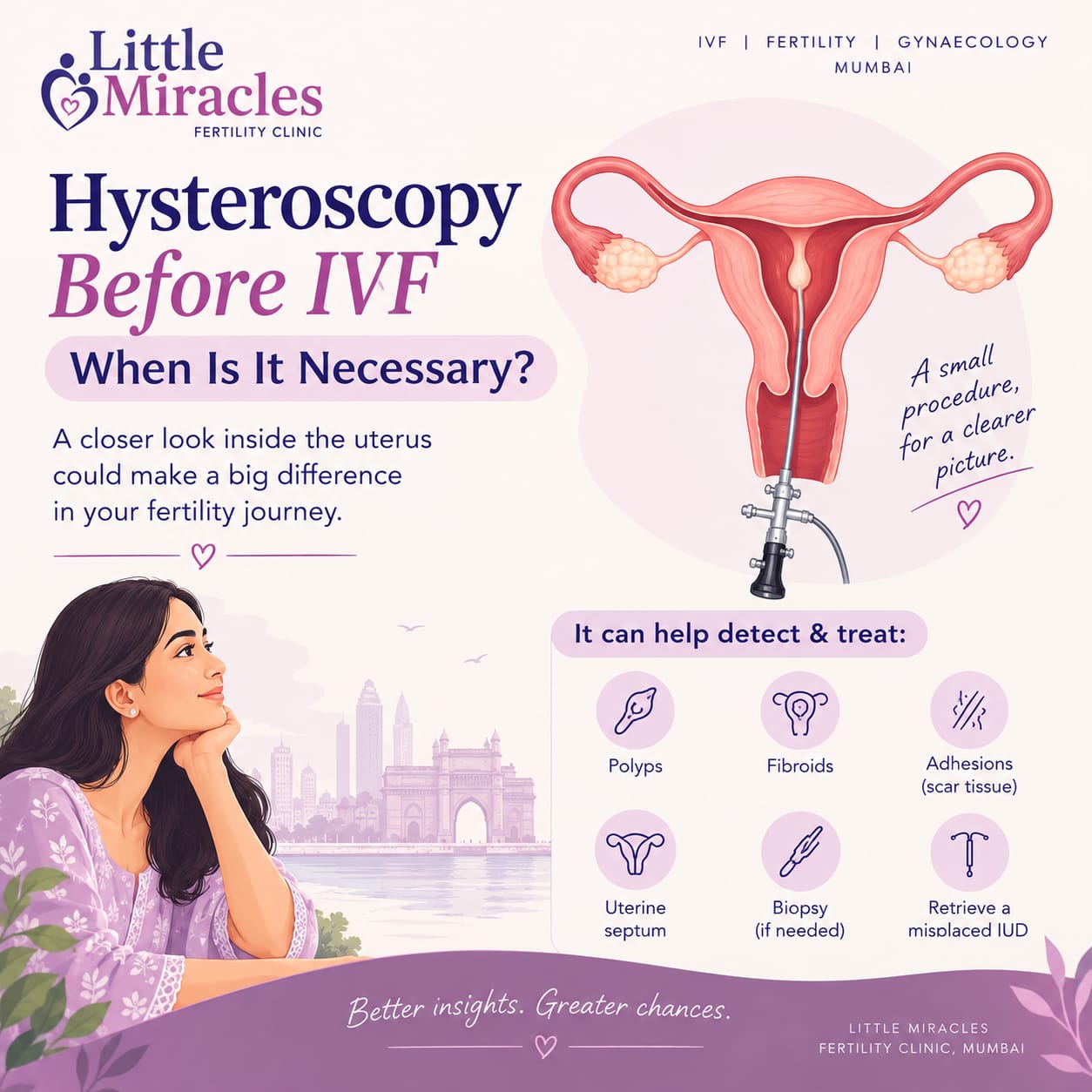
Hysteroscopy is a minimally invasive procedure that allows your gynaecologist to directly examine the inside of your uterus using a thin, lighted telescope-like instrument called a hysteroscope.
The instrument is gently passed through the vagina and cervix into the uterine cavity. Saline is used to gently expand the cavity, allowing the doctor to examine the uterine lining and identify abnormalities.
Unlike an ultrasound, hysteroscopy provides a direct view of the uterine cavity. It can also allow treatment of certain abnormalities during the same procedure.
Think of the uterus as the place where an embryo needs to settle and develop. For successful implantation, the uterine cavity should ideally have a suitable shape and a healthy lining.
Even when embryo quality is good, abnormalities inside the uterine cavity may sometimes interfere with implantation or contribute to pregnancy loss. This is why evaluating the uterine cavity is an important part of fertility assessment.
Hysteroscopy is particularly useful in selected situations:
A good-quality transvaginal ultrasound, saline infusion sonography (SIS), or 3D ultrasound provides valuable information. However, some small polyps, fine adhesions, and subtle cavity abnormalities may not always be clearly identified on routine imaging.
Remember: Hysteroscopy is not compulsory for every woman undergoing IVF. Evidence does not support performing routine hysteroscopy in all women with a normal uterine cavity simply to improve IVF success rates. The decision must be individualized.
The answer depends on what is found. If a significant cavity abnormality is detected and appropriately treated, correcting it may improve the uterine environment and reproductive outcomes in selected patients. However, hysteroscopy itself is not a cure-all for every cause of implantation failure.
Hysteroscopy may be performed as a diagnostic or operative procedure under general anaesthesia depending on individual circumstances. The procedure generally takes around 15–30 minutes.
Hysteroscopy is generally safe when performed by a trained specialist. Some women may experience mild period-like cramps, light vaginal bleeding, or spotting for a few days. Rare complications include infection or uterine perforation.
Every IVF journey is different. While embryo quality, age, and ovarian reserve are crucial, the uterine cavity also deserves careful attention. Hysteroscopy is a valuable tool when there is a specific indication. A well-planned IVF journey begins with the right investigations, at the right time, for the right patient.
Consult with our expert specialists, Dr. Tejal Poddar and Dr. Shreedevi Tanksale, across our clinics in Charni Road, Vile Parle, Juhu, and Andheri.